

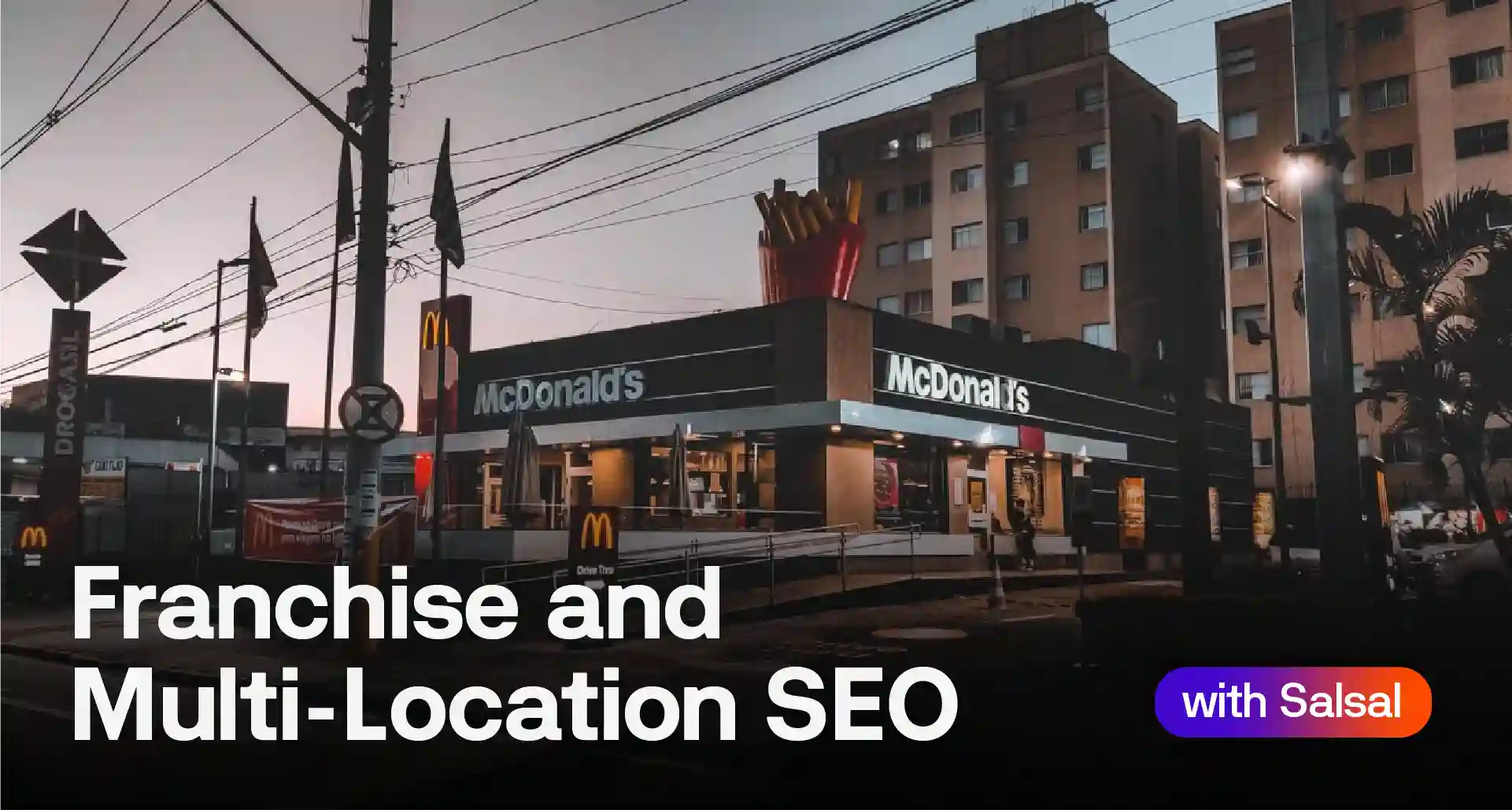
Running SEO for one location is a challenge. Running it for 10, 50, or 500 locations is a different problem entirely.
Multi-location SEO has its own set of challenges: site architecture decisions that affect every location simultaneously, GBP management at scale, and the very real problem of your own locations competing against each other in search results.
This guide covers how franchise and multi-location businesses build an SEO system that ranks every location without cannibalization.
Why Multi-Location SEO Is Its Own Discipline
Single-location SEO is fundamentally different from multi-location SEO. The decisions are bigger, the risks are higher, and the tactics that work for one location can actively hurt you when applied across 50.
A local business deciding what category to put on their GBP is a low-stakes call. A franchise system making that same call affects 200 locations simultaneously. Get it wrong and you’ve introduced a systemic problem across your entire network.
Multi-location SEO requires a strategy that works at scale: consistent enough to maintain brand integrity, flexible enough to allow genuine local customization, and structured enough to prevent locations from competing against each other.
The Core Multi-Location SEO Challenges
1. Site Architecture (One Domain or Sub-Domains?)
This is the most impactful decision in multi-location SEO. Where each location lives on your website affects everything else.
2. Cannibalization (Locations Stealing Each Other’s Rankings)
When two location pages target the same keyword – “[service] [nearby city]” – Google can’t decide which to rank. Both suffer. This is keyword cannibalization, and it’s extremely common in franchise networks.
3. Brand Consistency vs Local Customization
Corporate wants every location to say the same thing. Local SEO requires each location to have genuinely unique content. These goals conflict. Finding the right balance is essential.
4. GBP Management at Scale
Managing one GBP takes a few hours a month. Managing 50 to 500 requires tools, processes, and clear ownership.
5. Reviews at Scale (and Review Quality Variance)
One location with a 2.8-star rating drags down brand perception across your entire network. Review strategy at scale requires centralized oversight with local execution.
Site Architecture for Multi-Location Businesses
Centralized Site with Location Pages (Best for Most)
One main domain with dedicated pages for each location. Structure: /locations/[city]/ or /locations/[state]/[city]/.
This is the right architecture for most franchise and multi-location businesses. All locations benefit from the domain authority of the main site. Corporate content (about, brand story, national campaigns) lives at the root. Each location has its own page for local SEO.
Example structure:
- yourfranchise.com/locations/chicago/
- yourfranchise.com/locations/dallas/
- yourfranchise.com/locations/miami/
Sub-Domain per Location (Rare, High-Risk)
Each location gets its own sub-domain: chicago.yourfranchise.com. Rarely justified. Creates massive technical overhead and splits domain authority across hundreds of sub-domains. Avoid unless you have very specific technical reasons.
Sub-Folder by Region or State
For very large franchises. Useful when state-level content makes sense.
Example:
- yourfranchise.com/illinois/chicago/
- yourfranchise.com/illinois/naperville/
- yourfranchise.com/texas/dallas/
Common Architecture Mistakes
- Separate domains per location (each at yourfranchise-chicago.com) – splits authority, multiplies cost, creates canonicalization nightmares
- No canonical tags on location pages
- Location pages with identical thin content
- No internal linking strategy across locations
Building Location Pages That Actually Rank
Location pages are the core of multi-location SEO. Done right, each one ranks for local searches in its city. Done badly, they’re penalized as thin doorway pages.
What Makes a Good Location Page
Every location page needs:
- 800 to 1,500 words of original, location-specific content
- Local phone number and address
- Hours of operation (location-specific, not generic)
- Embedded Google Map for that specific location
- LocalBusiness schema markup
- Real photos of the actual location (interior, staff, exterior)
- Local customer reviews for that specific location
- References to local neighborhoods, landmarks, or events
- Links to relevant service pages
The test: does this page provide unique value to someone in this specific city? If you swapped the city name and nothing else changed, the page fails.
Avoiding the “Thin Doorway Page” Penalty
If you have 50 location pages built on the same template with only the city name, phone number, and address changed – Google will filter them. They’re treated as doorway pages and either not ranked or actively penalized.
Each location page must be genuinely unique. Yes, this is more work. Yes, it’s worth it.
Templates That Allow for Local Customization
The hybrid approach works well at scale. About 60% of the location page follows a consistent template (brand standards, service descriptions, CTAs). The other 40% is genuinely local content added by someone with knowledge of that location.
Local content to add:
- A paragraph about the local team or franchisee
- Mention of specific neighborhoods or areas served
- Local testimonials or reviews
- Community involvement or local events the location participates in
- Location-specific photos
Local Pages and Internal Linking
Each location page should link to:
- Relevant service pages on the main site
- Nearby location pages (helps Google understand geographic relationships)
- The main locations directory page
A good internal linking structure also passes authority from well-performing pages to newer or weaker location pages.
Google Business Profile at Scale
Bulk Verification (Google’s Bulk Process for 10 or More Locations)
For businesses with 10 or more locations, Google has a bulk verification process that avoids verifying each location individually. Apply through Google Business Profile Manager. You’ll submit a spreadsheet with all location information and typically verify via a video call with Google.
This process is essential for franchise systems. Individual location verification at scale is impractical.
GBP Management Platforms
| Platform | Best For | Strengths |
| Yext | Large enterprises | Broad publisher network, fast updates |
| Birdeye | Mid-market multi-location | Reviews + GBP in one platform |
| Synup | Agencies and franchises | Strong location data management |
| BrightLocal | SMBs and agencies | Good reporting and citation management |
At 50+ locations, manual GBP management isn’t viable. A platform is necessary.
Consistency vs Local Optimization
Corporate-controlled GBP posts ensure brand consistency. Locally-controlled posts ensure local relevance. Neither is perfect alone.
The best approach: corporate creates a content calendar and templates. Local managers add location-specific posts within that framework. Clear guidelines for both sides.
Photos: Centralized Stock vs Local-Generated
Local-generated photos outperform stock photos every single time. A photo of the actual team at the Dallas location builds more trust than a generic brand photo.
Build a process for locations to submit real photos. Make it easy. Provide simple photo guidelines (lighting, composition, what to shoot). The quality difference in search results is measurable.
Local Citations and NAP at Scale
Data Aggregator Strategy
At scale, updating 50 to 500 directories manually is not feasible. Use data aggregators as the primary mechanism:
- Data Axle: Feeds hundreds of downstream directories
- Foursquare: Powers Apple Maps and many others
Getting your NAP correct in the aggregators propagates corrections across the broader citation ecosystem automatically.
NAP Consistency Across Locations
With 50 locations, you’ll inevitably have NAP variations across directories. Standardize your format:
- Business name: “[Brand Name] – [City]” or “[Brand Name] [City]” – pick one format and stick to it
- Phone: consistent format across all locations
- Address: consistent abbreviation style (Street vs St)
Inconsistencies at scale compound into a significant trust problem for your overall domain.
When Locations Move or Close
Have a documented protocol:
When a location moves:
- Update GBP immediately
- Update main aggregators (Data Axle, Foursquare)
- Update the location page on your website
- Set up a 301 redirect if the page URL changes
When a location closes:
- Remove or sunset the GBP listing
- 301 redirect the location page to the nearest location or the main locations directory
- Remove from aggregators
Review Generation and Management at Scale
Centralized Tools vs Per-Location
Review management at scale requires a centralized platform. Per-location management leads to inconsistent follow-up, missed reviews, and no network-wide visibility.
Platforms like Birdeye, Podium, or Yotpo allow you to:
- See all reviews across all locations in one dashboard
- Set up automated review requests for every location
- Monitor response times per location
- Identify locations that are underperforming on reviews
Cross-Location Review Quality Variance
This is the franchise SEO problem that keeps corporate marketing managers up at night. One location with terrible reviews can drag down brand perception in that market even when other locations are performing well.
Build an accountability system:
- Monthly review performance reporting per location
- Minimum review targets per location (volume and rating)
- Escalation process when a location falls below standards
- Support for locations that need help with their review strategy
Response Templates with Local Flexibility
Create corporate-approved response templates that local managers can personalize. The corporate template ensures brand-appropriate tone and legal compliance. The local personalization makes responses feel authentic.
Keep it simple: two to three template variations for positive reviews, two to three for negative reviews, one for fake or disputed reviews.
Local Content vs Corporate Content
Corporate-Created Local Templates
Pros: consistent quality and brand standards. Easy to scale.
Cons: generic, lacks genuine local relevance, and Google can detect when 50 pages use the same language with minor variations.
Use corporate templates for structure and brand standards. Never rely on templates for the local content sections.
Local-Created Content (Distributed Authorship)
Pros: genuine local relevance, authentic voice, unique content that Google rewards.
Cons: inconsistent quality, hard to manage at scale, requires local team training and time investment.
The highest-performing location pages are created by people who know the local market. But this requires a system and support from corporate.
Hybrid Model (Most Common Best Practice)
Corporate creates the framework (template structure, brand guidelines, content requirements). Local managers or franchisees add the 40% local content.
To make this work:
- Provide clear content guidelines and examples of good local content
- Make it easy (a simple form or CMS that pulls local content into the template)
- Build review and quality check into the process before publishing
- Recognize and reward franchisees who create high-quality local content
Cannibalization: Diagnosis and Fixes
How Cannibalization Happens
Two location pages both target “[service] [nearby city].” For example, your Chicago location and your Evanston location both target “plumbing services near [overlapping area].” Google can’t decide which page to rank for the overlapping geography. Both pages perform worse than one strong page would.
Cannibalization is especially common when:
- Locations are in close geographic proximity
- Service area pages overlap significantly
- Location pages use identical or near-identical content
How to Diagnose Cannibalization
Use Google Search Console:
- Filter performance by query
- For each key query, which pages are getting impressions and clicks?
- If two pages are both getting impressions for the same query and neither is getting clicks, you likely have cannibalization
In Ahrefs or Semrush:
- Use the “Content Gap” or “Keyword Cannibalization” features to identify pages competing for the same keywords
Fixes: Consolidate, Differentiate, or Canonicalize
| Situation | Fix |
| Two very similar pages targeting overlapping area | Consolidate into one stronger page |
| Pages are genuinely different but targeting the same keyword | Differentiate content and target unique keywords per page |
| One page clearly more authoritative | Canonicalize the weaker page to the stronger one |
Link Building for Franchises
Corporate-Level Authority (National Press, Partnerships)
Links earned by the corporate brand benefit every location. National press coverage, brand partnerships, industry association involvement – these build domain authority that lifts the performance of every location page.
Corporate marketing’s link building efforts are multi-location SEO investments.
Local-Level Authority (Local Press, Community Involvement)
Individual location links – from local news, community organizations, local sponsorships – lift individual location pages and add geographic relevance signals.
Encourage franchisees to:
- Sponsor local events
- Join the local chamber of commerce
- Participate in community programs
- Reach out to local press for coverage of local milestones
Franchise-Specific Directories
Don’t overlook franchise industry directories:
- Franchise.com
- International Franchise Association (IFA)
- Entrepreneur Franchise 500
- Franchise Direct
These directories rank well and provide both citation value and relevant backlinks.
Measuring Multi-Location SEO
Per-Location Local Rank Tracking
Track local rankings for each location individually. A location appearing at position 3 in Denver and position 12 in Dallas are two very different performance situations.
Tools:
- LocalFalcon: Tracks your exact local Map Pack position at specific coordinates
- BrightLocal: Good for rank tracking across location sets
Roll-Up Reporting for Corporate
Corporate needs to see network-wide performance. Build a dashboard that shows:
- Average organic traffic across all location pages
- Average Map Pack position across all GBPs
- Network-wide review average and total review count
- Number of locations in top 3 Map Pack vs below top 3
- Month-over-month trend
Identifying Underperforming Locations
Some locations will consistently underperform. When you identify them:
- Is the GBP incomplete or unclaimed?
- Does the location page have thin content?
- Are reviews low in volume or rating?
- Is the local market more competitive?
- Has there been a recent management change that disrupted operations?
Build a regular underperformer review into your reporting cadence and have a standard intervention playbook.
Common Franchise SEO Mistakes
- Identical location page templates with nothing but city name and contact info changed
- No local content – everything written by corporate with no local input
- Corporate over-controlling GBP – no local posts, no local photos
- Ignoring local reviews or having no accountability system
- No per-location rank tracking (only aggregate reporting)
- No protocol for location moves or closures
Franchise SEO Pricing
Franchise SEO is priced by the number of locations managed:
table:
| Scale | Monthly Cost |
| 10 to 50 locations | $5,000 – $15,000/mo |
| 50 to 500 locations | $15,000 – $50,000/mo |
| 500 or more locations | Custom, typically $50,000+/mo |
Per-location costs decrease with scale, but the absolute investment is significant. The ROI math works when you account for the revenue value of even one additional customer per location per month.
How Long Does Franchise SEO Take?
- GBP optimization across all locations: 60 to 120 days for initial improvements
- Location page rankings: 4 to 8 months in most markets
- Full network lift: 9 to 15 months for significant traffic and lead impact across the network
Franchise SEO timelines are longer than single-location SEO because of the scale of implementation and the time required to address each location’s unique situation.
Frequently Asked Questions
Should each franchise location have its own domain?
Almost never. Separate domains split authority, multiply costs, and create enormous technical complexity. One domain with location sub-folders is the right approach for most franchise systems.
How do I prevent locations from creating their own Google Business Profiles without authorization?
Use Google Business Profile Manager to claim and own all locations centrally. Establish brand guidelines for GBP that franchisees must follow.
What’s the biggest ROI opportunity in franchise SEO?
GBP optimization and review management across all locations. The Map Pack is where most local customers find you, and improving GBP performance across 50 locations has 50x the impact of improving one location.
Can franchise SEO hurt locations that are already ranking well?
Yes, if done incorrectly. A site architecture migration or bulk content update can temporarily impact existing rankings. Changes need to be implemented carefully with proper redirects and monitoring.
Do I need different agencies for corporate and local SEO?
Not necessarily. A franchise SEO agency that understands both national brand building and local market execution is more effective than splitting the work between two agencies with different priorities.
Schedule a Franchise SEO Strategy Call
Multi-location SEO is complex. The right architecture and strategy from the start saves months of painful fixes later. Salsal Digital Marketing works with franchise systems and multi-location businesses to build SEO programs that scale.